





Uj Muveszet - Gabor Reider - 2005. 16.évf. 12.szám
It seems, that over the years the Strabag Artist's Award has become an important event in the structured around contemporary fine art. Sixty- two young artists have submitted one hundred eighty two pieces of art work to compete in this year's competition that was announced for the nineteenth consecutive time. The construction firm headquartered in Köln, last year alone has turned 678 million euros in our country. Thus the help of the young artists could not have been a measurable burden on them. Then again, for the native, young artists who depend on the tight fisted system of competitions the Strabag Award has a model value: how can the business sector and the philanthropy in a productive way blend in the ripe stage of capitalism. For the artist in her budding career, aside from the money, the award means media coverage and a guaranteed entrée into a closed scene. This year the expanded panel of the jury (Dr. Hegyi Lorand, Jerger Krisztina, Kovalovszky Marta, Neray Katalin and Dr. Petranyi Zsolt) awarded the top prize to Dorottya Szabo, which Attila Adorjan, Zsuzsa Moizer, Nora Soos and Dezso Szabo received support of their creativity. We could have seen their work earlier in group exhibition and in many individual shows as well. The five career starter (or more precisely creating in the first half of their life's work) artists represent a very divergent direction, The jury has awarded the different styles in proportion following the motto of heterogeneousness.
Conceptual visions.
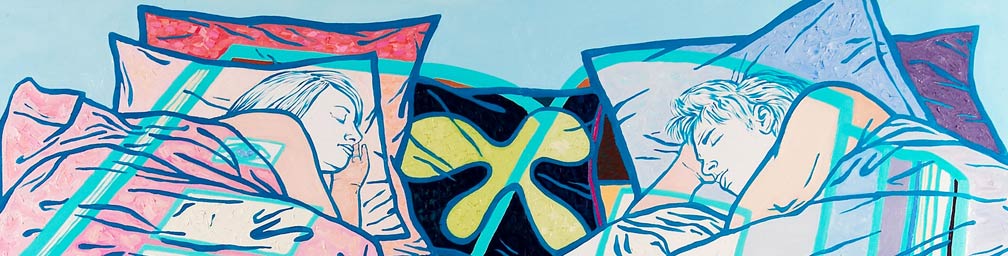
Difficult to categorize, synthesize, intellectual art; Dorottya Szabo (1975) sounds off in a low - keyed, non boastful but sure tone. She lives with minimal tools, but the careful selection still suggest, that here everything has a meaning, the outline of the lacquer shine of a green blotch and the reversal of the blurred portrait too. The heavy conceptualization is preceded by her studies: along MKE Dorottya Szabo took philosophy, attended the Academy in Munich, and currently is working on her doctorate degree. Her earlier work came out of the marriage of oil-canvas technique and the textile art of the seventies. At the beginning the knitting threads provided the silhouette, later the embroidering treads, sewing treads became the main carriers of the meaning by their material, object like presentation. The textiles steeped in abstract thinking are the inheritors of the traditional and discrete "female art" in a post - modern "feminine art" without the frivolous trendiness and clichés. Later Szabo changed around the woven fabric, and switched the material and the technique: she cut strips off her aquarelles and wove them in a chess board fashion. Her newest current paintings already showing the fuzzy face and the strange blotch that at times looks like the contour map of Greater Hungary, or a cross section of the brain and spinal column, or at times an oak tree full of leaves, also visible on her award winning painting. Szabo does not just simply smear the face and the blotch to give the canvas a more lyric charge, but in a unique way presses it from another surface. The prints like fuzzy blotches are fixed by the application of lacquer. As if we would be looking at the back side of a tapestry, a picture turned inside out, the print of the past: a memory fragment weighs on as heavy ballast spread on the surface of our consciousness. It remains the secret of the unconscious, the locked in meaning; the continuous remembering raises its symbolic meaning. The opening key of the lean conceptualization is the vision of mnemotechnique that we find on the canvases of Dorottya Szabo.
Angyal Ego. (Ego of an Angel)
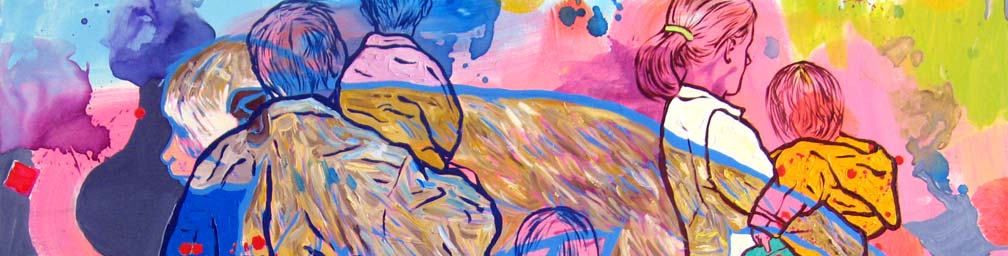
The statement without punctuation marks - the title of the series - seams incomplete: Angyal van (Angel is). But who this angel is, is not clear at once from the award winning painting of Zsuzsa Moizer (1979). The mysteries lead to personality building self mythology. Wide eyed, scared and an identity seeking sad female faces. The cut outs often remove an ear, the forehead or sometimes a chin. The shape is not subtle, but troubled and rambling. On the oil - canvas - paintings of Moizer the lyrical creativity of an aquarellist shows through: the poetically simple, layered blotches are in reality the vibrations of the soul's seismographic signs.
- 2013.június. XXIV. évf.6.szám
168 Óra - András Jolsvai - 2013. (XXV. évfolyam) - 15. lapszám
Magyar Narancs - Kriszta Dékei - 2013.április 4.
- 2012/2
- 2010.november.XXI.évf.11.szám
- 2010.okt.3
- 2009. 10. 17.
- LIII. Évf. 43. szám, 2009. okt.22
- XXI. Évf. 43. szám, 2009. okt. 22.
- 2009/01. VII. évfolyam
- 2008.09.11
- 2008.09.10.
Nepszabadsag - Gyula Rózsa - 2006.12. 20.
168 Ora - Andras Jolsvai - 2006.12.22.
Magyar Narancs - Sisso - 2006. 18.évf. 46.szám
repertoArt
Diploma magazine - 2006. 7.évf. 10.szám
Vas Nepe - Livia Olbei - 2005.12.24.
Vas Nepe - 2005. 50.évf. 289.szám
168 Ora - Andras Jolsvai - 2005. 17.évf. 12.15.
Interior - Edina Nagy - 2005.12.-2006.01
Muerto - Katalin Spengler - 2005. 11.
Elite magazine - Katalin Spengler - 2005. 06.
Uj Muveszet - Brigittal Muladi - 2004. 15.évf. 11.szám
Elet es Irodalom - Istvan Antall - 2004. 47.évf. 45.szám
Budapester Zeitung - 2004. 6.évf. 43.szám
Uj Muveszet - Zsofia Somogyi - 2004. 15.évf. 9.szám
Balkon - Kriszta Dekei - 2004. 5.évf. 5.szám
Art Press Magazine - 2004. 2.évf. 5.szám
2 Giraffe magazine - 2004.05
Vas Nepe - Livia Olbei - 2004. 49.évf. 29.szám
Uj Muveszet - Lajos Loska - 2003. 14.évf. 12.szám
Feamale artists of Vas County
Vas Nepe - Livia Olbei - 2002.10.19
Uj Muveszet - Klara Hudra - 2002. 12.évf. 09.szám
Magyar Narancs - 2002. 14.évf. 22.szám
Vas Nepe - Livia Olbei - 2002. 47.évf. 126.szám
Vas Nepe - 2002. 47.évf. 124.szám
168 Ora - Andras Jolsvai - 2002. 16.évf. 22.szám
Muerto - 2002. 5.évf. 2.szám
Vas Nepe - 2001.11.09.
Collectors and Collections - Bogdándy Zoltán Szultán - 2001. 5-6.
Balkon - Eszter Radak - 2001. 2.évf. 5.szám