





Mozgo Vilag - Gyorgy Varkonyi - 2006.12.
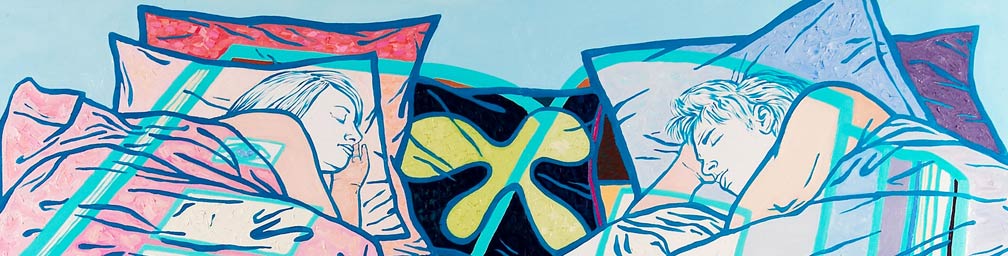
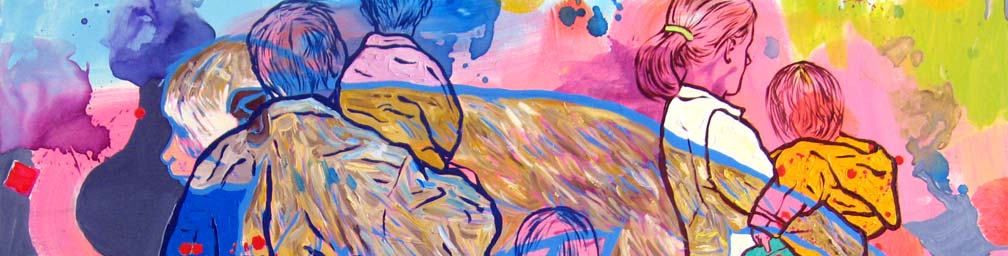
After 1910 - Malevics and Duchamp -we can prove just about anything in fine arts that it is a quote - Reflection. A repeat which of course is well known as the mother of knowledge. That is a given - let us say - that the knowledge of history is impossible to eliminate from the process of creation. Among other things, this is what George Kubler recognized when he wrote "The Form of Time" which at least put the style developmental theory of the science of Art History in parenthesis. The paintings of Nora Soos often invokes the statement that "I feel like I have seen this somewhere before". What makes her paintings an iconographic treat (iconography = the study of pictures of a particular subject) is what found by others and invented by others and published on other channels, used by media pictures (wars, natural catastrophic events) and icons (well known figures, cartoon characters) are used, shaken up in a kaleidoscope, what she fits on to a square canvas that is derived from a traditional window metaphor. This canvas, this frame however is neither a mirror nor a window since it does not function as a cut out. Instead of glancing through a gap opened for viewing or what is interchangeable with it the mirror (cf.: Rene Magitte) it is like looking into a Petri-dish through the lens of a microscope. Below, in the well lit transparent field the time frames are piling up, scales are blending and the stories that take place in different cultural layers are having a rendezvous. On the surface it is like when the flood carries objects of distant places and times, mercilessly disregarding the hierarchy of any kind of order, rank, system or value. In the sediment or deposit in the occasional creation of an ensemble nothing else seems to dictate but the morphology of the actual water level and the groove. In this mixture the crown jewels of art history and the pictures of banality, the toy and the real soldier, the fairy tale, a report and a tragedy become homogeneous. The presentation of motifs in a visual indifference so pounds the undifferentiating of the montage as a fashionable cultural anthropology essay in which it is not proper to differentiate between a tattoo and the Capella Sistina. Crafty illusion that is further strengthened by the sanctified lines, like the use of a stencil in a trivial embroidered wall hanging by the designer.
Let's see! The spirit of Islamic fundamentalism rises from Aladdin's lamp, and Manhattan's Twin Towers are still standing just before the impact in the background of a little girl munching on an apple. Ophelia by Millais (pre - Rafael) is floating among the flooded homes of New Orleans and names of cartoon or media icons (Wilma, Katrina) invoke devastating hurricanes. What we are dealing with is a decipherable puzzle that can not be solved without the knowledge of the events, stories, tales and history. The believer of a native, aboriginal religion would not be able to identify the thirteen people sitting around the table in the Last Supper. These pictures are aimed at us average people who are (half)cultured, living with visual and historical clichés thrown into a trance by the TV screen and the shop windows, attached to the international brands lies of universal proportion and sometimes a Pinocchio sometimes playing the role of the unrelenting toy soldier. Parable, like the poems on a kitchen wall hanging. On top of that, the method is familiar. The schematic contour drawing of the motifs without scale, proportion and guidance (that is enlarged and turned around) mounted on tops of each other: this method was called constructive surrealism by Vajda and Korniss at Szentendre in around 1935. Incidentally, they too have used newspaper photos. Their goals and their materials were completely different. They wanted to bridge the gap between Eastern and Western, rustic and universal, ad hoc and general. Their program died because it lacked the social medium. It is possible that their methods will become alive again by the globalization and the information dumping of a post-modern media society.
- 2013.június. XXIV. évf.6.szám
168 Óra - András Jolsvai - 2013. (XXV. évfolyam) - 15. lapszám
Magyar Narancs - Kriszta Dékei - 2013.április 4.
- 2012/2
- 2010.november.XXI.évf.11.szám
- 2010.okt.3
- 2009. 10. 17.
- LIII. Évf. 43. szám, 2009. okt.22
- XXI. Évf. 43. szám, 2009. okt. 22.
- 2009/01. VII. évfolyam
- 2008.09.11
- 2008.09.10.
Nepszabadsag - Gyula Rózsa - 2006.12. 20.
168 Ora - Andras Jolsvai - 2006.12.22.
Magyar Narancs - Sisso - 2006. 18.évf. 46.szám
repertoArt
Diploma magazine - 2006. 7.évf. 10.szám
Vas Nepe - Livia Olbei - 2005.12.24.
Vas Nepe - 2005. 50.évf. 289.szám
168 Ora - Andras Jolsvai - 2005. 17.évf. 12.15.
Interior - Edina Nagy - 2005.12.-2006.01
Muerto - Katalin Spengler - 2005. 11.
Elite magazine - Katalin Spengler - 2005. 06.
Uj Muveszet - Brigittal Muladi - 2004. 15.évf. 11.szám
Elet es Irodalom - Istvan Antall - 2004. 47.évf. 45.szám
Budapester Zeitung - 2004. 6.évf. 43.szám
Uj Muveszet - Zsofia Somogyi - 2004. 15.évf. 9.szám
Balkon - Kriszta Dekei - 2004. 5.évf. 5.szám
Art Press Magazine - 2004. 2.évf. 5.szám
2 Giraffe magazine - 2004.05
Vas Nepe - Livia Olbei - 2004. 49.évf. 29.szám
Uj Muveszet - Lajos Loska - 2003. 14.évf. 12.szám
Feamale artists of Vas County
Vas Nepe - Livia Olbei - 2002.10.19
Uj Muveszet - Klara Hudra - 2002. 12.évf. 09.szám
Magyar Narancs - 2002. 14.évf. 22.szám
Vas Nepe - Livia Olbei - 2002. 47.évf. 126.szám
Vas Nepe - 2002. 47.évf. 124.szám
168 Ora - Andras Jolsvai - 2002. 16.évf. 22.szám
Muerto - 2002. 5.évf. 2.szám
Vas Nepe - 2001.11.09.
Collectors and Collections - Bogdándy Zoltán Szultán - 2001. 5-6.
Balkon - Eszter Radak - 2001. 2.évf. 5.szám