





Elet es Irodalom - Andrea Bordacs - 2006. 50.évf. 2.szám.
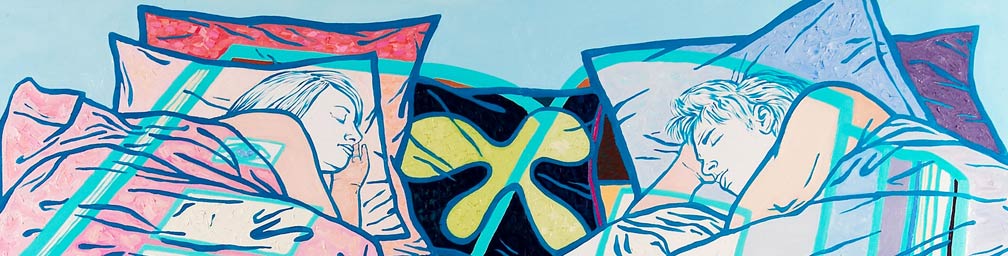
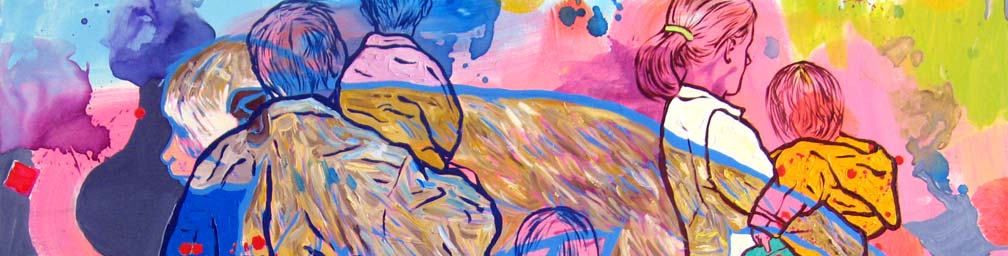
Glitzy colors, swirling lines, even at the first glance it provides lasting impression so much so, that we may think of mere decorations when we view these paintings. However, when we look at them more carefully, we can see, that we are dealing with permanent self - reflection and identity search.
Moreover, looking at the more important creations of an entire career, we can also experience a sense of recurring motifs and tendencies. At the beginning we could find paintings of objects, primarily of shoes and at times umbrellas. Upon them are pigment blotches as if they just accidentally happened, more precisely a guided accident leaving it to the sense of aesthetics. Then these appeared on the paintings and from there the next step for the shoes were to appear to be the subject of art. In Cinderella (Hamupipoke) Nora Soos makes her viewing princes work hard, since it is not just one shoe that serves to identify the owner. That is to say, what radiates out of this swirling, collage like mass of objects is versatility, colorfulness, many styles and life style's simultaneous undertaking. According to the famous adage of Buffon "The style is the person". Following this saying then the multiple styles hide multiple personalities, more precisely, show them to us.
On the paintings of Nora Soos the parallel interplay of self-search and self - finding happens. So much so, that the viewer almost feels embarrassed by the openness of reflection what at first sight she hides, but it is just that, that dissolves the intimacy. In her pictures the figures are never shown in their physical wholeness, only drawn as an outline. There are no detailed faces, hands; the bodies of people are only present symbolically. The identities of her characters are not portrayed by their facial features, but by the objects surrounding them. Since the characters of Nora Soos' paintings are primarily she, therefore the series of these paintings can be considered as self - portraits, even creed (ars poetica). In biology the genotype marks the genetic stock; the phenotype shows the effect of the environment on the genes. In philosophy this is the way they use the term phenotype as it applies to personality, thereby meaning that it is not just the physical characteristics that define a person, but the habits, family traditions, hobbies, etc. The elements, objects and situations that fall outside of the physical abilities in Nora Soos' paintings are better describing her personality. This is an important viewpoint because the physical presence, the body as the carrier of the symbolic phenomenon is always an important component, a regulator of the ego's expansion and boundaries, and in the partner and social relationships. In earlier times, the ego - boundaries were controlled by the outer forces of national, ethnic, social class, social rank and group boundaries etc. Today, it became the exclusive responsibility of the individual to create the boundaries of his own ego, and to build it up. This way, tools of the self building are the form of dressing, behaving, what we read and the way we spend our free time. In this case, just what are the tools of self building? On one hand, the symbols of femininity - shoes, clothes, nail polish and the everyday events - shopping, relaxation - are all high-lighted in her paintings. On the other hand, the predecessors in art history, the role models, and the determinant works of art (Oldenburg, Erdely, Van Eyck, Falanagen, Cezanne, etc) are all heavily present. In talking about art we always try to frame what we see and therefore the question "Who this child takes after?" comes up. The definition in the present case is somewhat troublesome, since in Nora's work abstraction and representational style are equally present. As far as the swirled linier motifs are concerned we could mention the works of Ghada Amer or Kriszta Nagy.
- 2013.június. XXIV. évf.6.szám
168 Óra - András Jolsvai - 2013. (XXV. évfolyam) - 15. lapszám
Magyar Narancs - Kriszta Dékei - 2013.április 4.
- 2012/2
- 2010.november.XXI.évf.11.szám
- 2010.okt.3
- 2009. 10. 17.
- LIII. Évf. 43. szám, 2009. okt.22
- XXI. Évf. 43. szám, 2009. okt. 22.
- 2009/01. VII. évfolyam
- 2008.09.11
- 2008.09.10.
Nepszabadsag - Gyula Rózsa - 2006.12. 20.
168 Ora - Andras Jolsvai - 2006.12.22.
Magyar Narancs - Sisso - 2006. 18.évf. 46.szám
repertoArt
Diploma magazine - 2006. 7.évf. 10.szám
Vas Nepe - Livia Olbei - 2005.12.24.
Vas Nepe - 2005. 50.évf. 289.szám
168 Ora - Andras Jolsvai - 2005. 17.évf. 12.15.
Interior - Edina Nagy - 2005.12.-2006.01
Muerto - Katalin Spengler - 2005. 11.
Elite magazine - Katalin Spengler - 2005. 06.
Uj Muveszet - Brigittal Muladi - 2004. 15.évf. 11.szám
Elet es Irodalom - Istvan Antall - 2004. 47.évf. 45.szám
Budapester Zeitung - 2004. 6.évf. 43.szám
Uj Muveszet - Zsofia Somogyi - 2004. 15.évf. 9.szám
Balkon - Kriszta Dekei - 2004. 5.évf. 5.szám
Art Press Magazine - 2004. 2.évf. 5.szám
2 Giraffe magazine - 2004.05
Vas Nepe - Livia Olbei - 2004. 49.évf. 29.szám
Uj Muveszet - Lajos Loska - 2003. 14.évf. 12.szám
Feamale artists of Vas County
Vas Nepe - Livia Olbei - 2002.10.19
Uj Muveszet - Klara Hudra - 2002. 12.évf. 09.szám
Magyar Narancs - 2002. 14.évf. 22.szám
Vas Nepe - Livia Olbei - 2002. 47.évf. 126.szám
Vas Nepe - 2002. 47.évf. 124.szám
168 Ora - Andras Jolsvai - 2002. 16.évf. 22.szám
Muerto - 2002. 5.évf. 2.szám
Vas Nepe - 2001.11.09.
Collectors and Collections - Bogdándy Zoltán Szultán - 2001. 5-6.
Balkon - Eszter Radak - 2001. 2.évf. 5.szám